import tbsim
import starsim as ss
import sciris as sc
import numpy as np
import matplotlib.pyplot as plt# Rendering with QuatroHIV Comorbidity in TBSim
This notebook demonstrates how to use the HIV comorbidity module in the tbsim package.
Module Location: tbsim/comorbidities/hiv.py
Overview
The HIV comorbidity module in TBSim allows users to simulate the impact of HIV infection on TB disease dynamics. Rather than modeling HIV progression in detail, it serves as a lightweight comorbidity that modifies TB risks based on HIV state.
The module is composed of three key components:
- HIV Model: Represents HIV infection as a comorbidity.
- HIV Intervention: Enables scenario testing via prevalence and ART coverage.
- TB-HIV Connector: Bridges HIV and TB models, applying comorbidity risk logic.
HIV Model
The HIV model simulates HIV infection status and its progression through simplified states:
ACUTELATENTAIDS
This implementation is intended as a modifier for TB outcomes, rather than a standalone disease model.
Key Parameters
| Parameter | Description |
|---|---|
init_prev |
Probability of being HIV-positive (ACUTE stage) at simulation start |
init_onart |
Probability of being on ART if HIV-positive |
acute_to_latent |
Daily probability of transitioning from ACUTE to LATENT |
LATENT_to_aids |
Daily probability of transitioning from LATENT to AIDS |
aids_to_dead |
Daily probability of death after reaching AIDS (currently unused) |
art_progression_factor |
Multiplier reducing HIV progression for agents on ART |
*** Important: ***
At step 0, the model looks for the existance of an
HivInterventionhandling the HIV infection and art coverage, if none is found then it uses the values defined at Disease level to set the initial values.
HIV Intervention
The HivIntervention class allows control over HIV prevalence and ART coverage in the population. This is useful for scenario testing and simulating public health campaigns.
Parameters
use_prevalence(bool): Whether to adjust HIV infection prevalence each stepuse_art(bool): Whether to adjust ART coverage each step
What It Does
- Applies changes to the HIV state of the population
- Operates within a specified time range (
starttostop) - Can be targeted to specific age groups or entire population
intervention = HivInterventions(pars=dict(
    use_prevalence=True,
    use_art=True,
    prevalence=0.2,
    percent_on_ART=0.5,
    min_age=15,
    max_age=49,
    start=ss.date('2000-01-01'),
    stop=ss.date('2010-12-31'),
))
Also, the parameters shown above are the same ones that you can modify in order to run a different scenario.
TB-HIV Connector
The TB_HIV_Connector class links the TB and HIV models, simulating the comorbidity effect of HIV on TB progression.
Purpose
Modifies TB progression parameters based on an individual’s current HIV state.
Risk Multiplier Table
| HIV State | TB Progression Risk Multiplier |
|---|---|
ACUTE |
1.5 |
LATENT |
2.0 |
AIDS |
3.0 |
Behavior at Each Time Step
- Identify all TB-infected individuals.
- Look up their current HIV state.
- Apply a multiplier to their TB
rr_activationvalue (risk of progressing to active TB).
Process Flow Diagram
+-----------------+
|   TB Infection  |
+-----------------+
        |
        v
+-----------------+     +-----------------------+
|  HIV Comorbidity| --> | HIV State (ACUTE,...) |
+-----------------+     +-----------------------+
        |                          |
        |      TB_HIV_Connector    |
        +-------------------------> Applies RR Multiplier
                                   |
                                   v
                    +-------------------------------+
                    | TB rr_activation Adjusted     |
                    | Based on HIV State            |
                    +-------------------------------+
Example Code
Example
Intervention
Adding a function to simplify the generation of an intervention.
This intervention will try to simulate a steady prevalence and on ART values along the entire simulation
def make_hiv_intervention(pars=None):
    if pars is None:
        pars=dict(
                use_prevalence=True,
                use_art=True,
                prevalence=0.30,            # Maintain 30 percent of the alive population infected
                percent_on_ART=0.50,        # Maintain 50 percent of the % infected population on ART
                min_age=15, max_age=60,     # Min and Max age of agents that can be hit with the intervention
                start=ss.date('2000-01-01'), stop=ss.date('2035-12-31'),   # Intervention's start and stop dates
        )
    intervention = tbsim.HivInterventions(pars=pars)
    return intervention
Creating the simulation
def build_tbhiv_sim(simpars=None, tbpars=None, hivinv_pars=None) -> ss.Sim:
    sim_pars = dict(
        dt=ss.days(7),
        start=ss.date('1980-01-01'),
        stop=ss.date('2035-12-31'),
        rand_seed=123,
        verbose=0,
    )
    tb_pars = dict(
        init_prev=ss.bernoulli(p=0.25),
    )

    hivinv_pars = hivinv_pars or dict(
        use_prevalence=True,
        use_art=True,
        prevalence=0.20,
        percent_on_ART=0.20,
        min_age=15, max_age=49,
        start=ss.date('2000-01-01'),
        stop=ss.date('2010-12-31'),
    )
    hiv_intervention = make_hiv_intervention(hivinv_pars)
    hiv = tbsim.HIV()
    connector = tbsim.TB_HIV_Connector()

    tb = tbsim.TB(pars=tb_pars)
    people = ss.People(n_agents=1_000)
    network = ss.RandomNet(pars=dict(n_contacts=ss.poisson(lam=2), dur=0))

    # --- Assemble Simulation ---
    sim = ss.Sim(
        people=people,
        diseases=[tb, hiv],
        interventions=[hiv_intervention],
        networks=network,
        connectors=[connector],
        pars=sim_pars,
    )
    return sim
Running the simulation
# Run the simulation:
sim = build_tbhiv_sim()
sim.run()
Sim(n=1000; 1980.01.01—2035.12.31; networks=randomnet; diseases=tb, hiv; connectors=tb_hiv_connector; interventions=hivinterventions)Plot the results
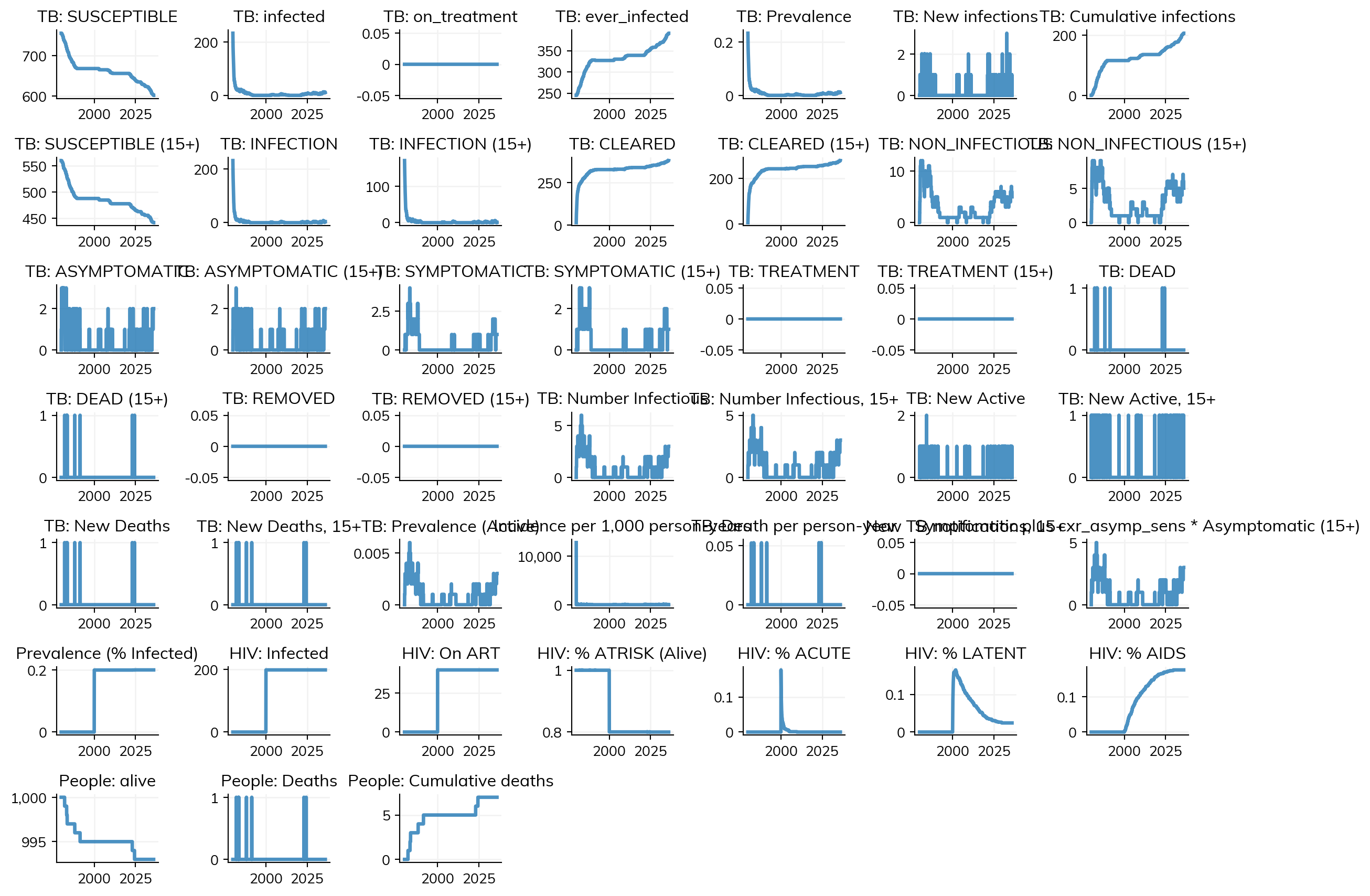
sim.plot()
plt.show()
Figure(1152x864)