An individual’s dose through long-cycle transmission in the model is attenuated or amplified by a mechanism for seasonality. Seasonality can represent an attenuation of the likely constant shedding of individuals into the long-cycle vehicle; a temperature-dependent growth in the level of CFUs in the environmental pool; changes to the rates of decay or removal of CFU from the environment; or any other method of seasonal forcing.
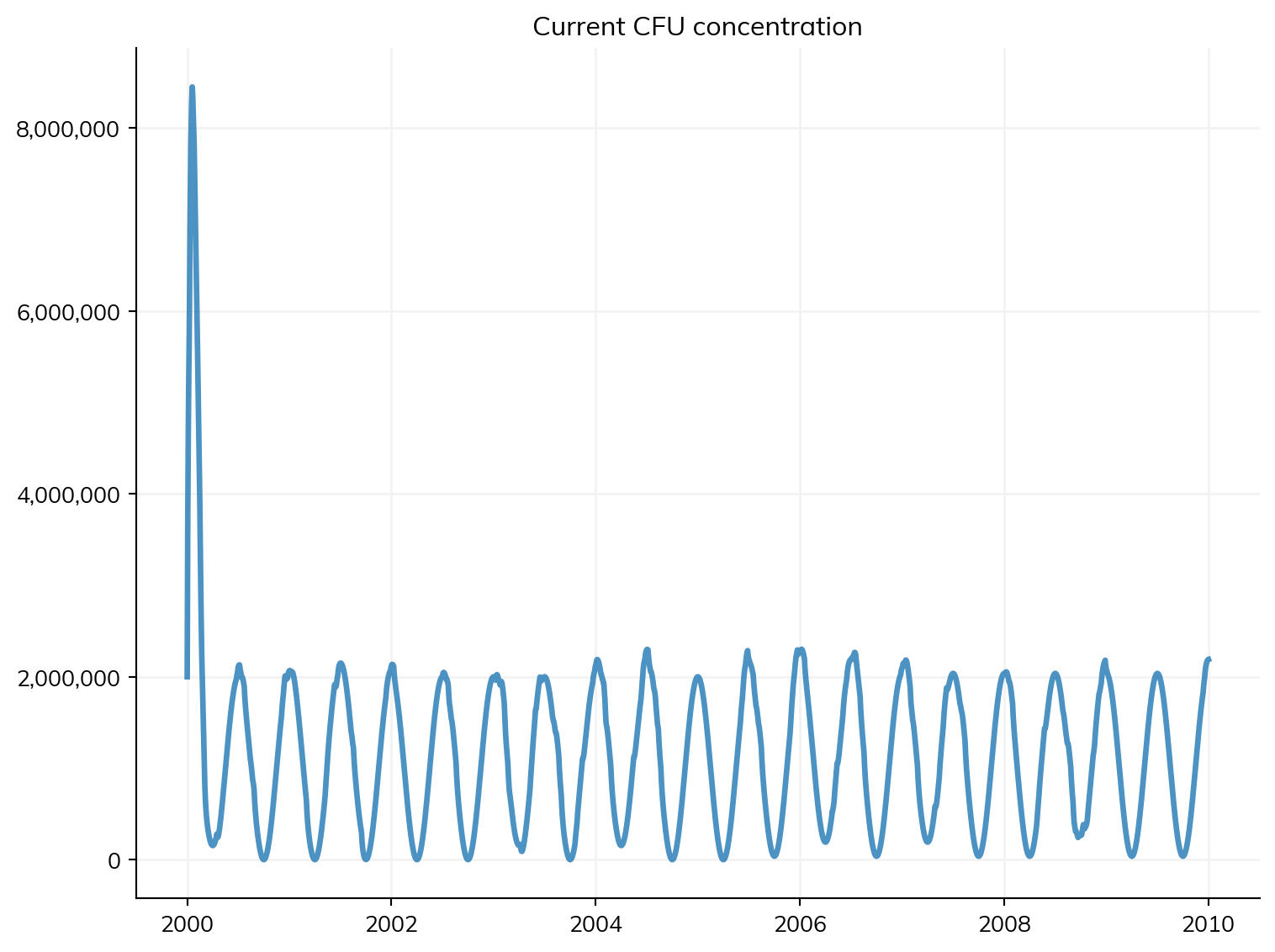
import starsim as ssimport typhoidsim as ty# Define high-level simulation parameterspars =dict( start =2000, # Starting year dur =10.0, # Duration of the simulation in years dt =1.0/365.0, # Timestep of 1 day, expressed in years verbose =0, # Do not print details of the run)# The populationppl = ss.People(10_000)# The disease, with reduced protection per infection `tppi` typhoid = ty.Typhoid(pars={'tppi':0.1})# The environment (long cycle CCVT)environment = ty.EnvironmentalPool()# Direclty modulates the level of CFUs in the environmentseasonal_pattern = ty.Pattern("baseline_cfu + amp_cfu * cos((2*pi/period)*var)", pars={'baseline_cfu': 1_000_000,'amp_cfu': 1_000_000,'period': 0.5, # in years'pi': 3.141592653589793})# This intervention adds to the current CFU level in the environment bacterial_growth = ty.environmental_seasonality(seasonal_pattern=seasonal_pattern)sim = ss.Sim( pars=pars, people=ppl, diseases=typhoid, demographics=environment, interventions=bacterial_growth, )sim.run()sim.plot(key=('environmentalpool_cfu_conc'))
Figure(768x576)
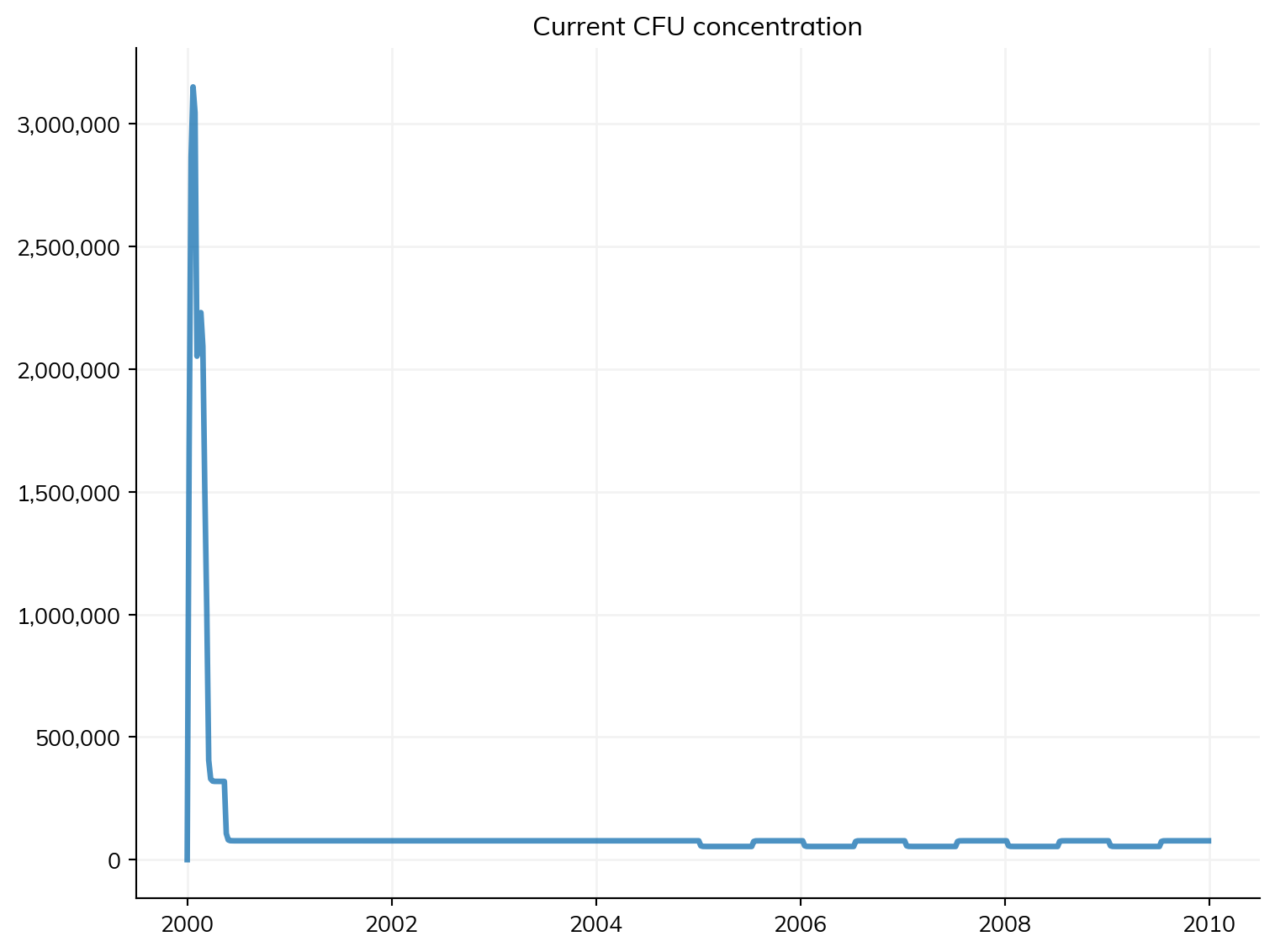
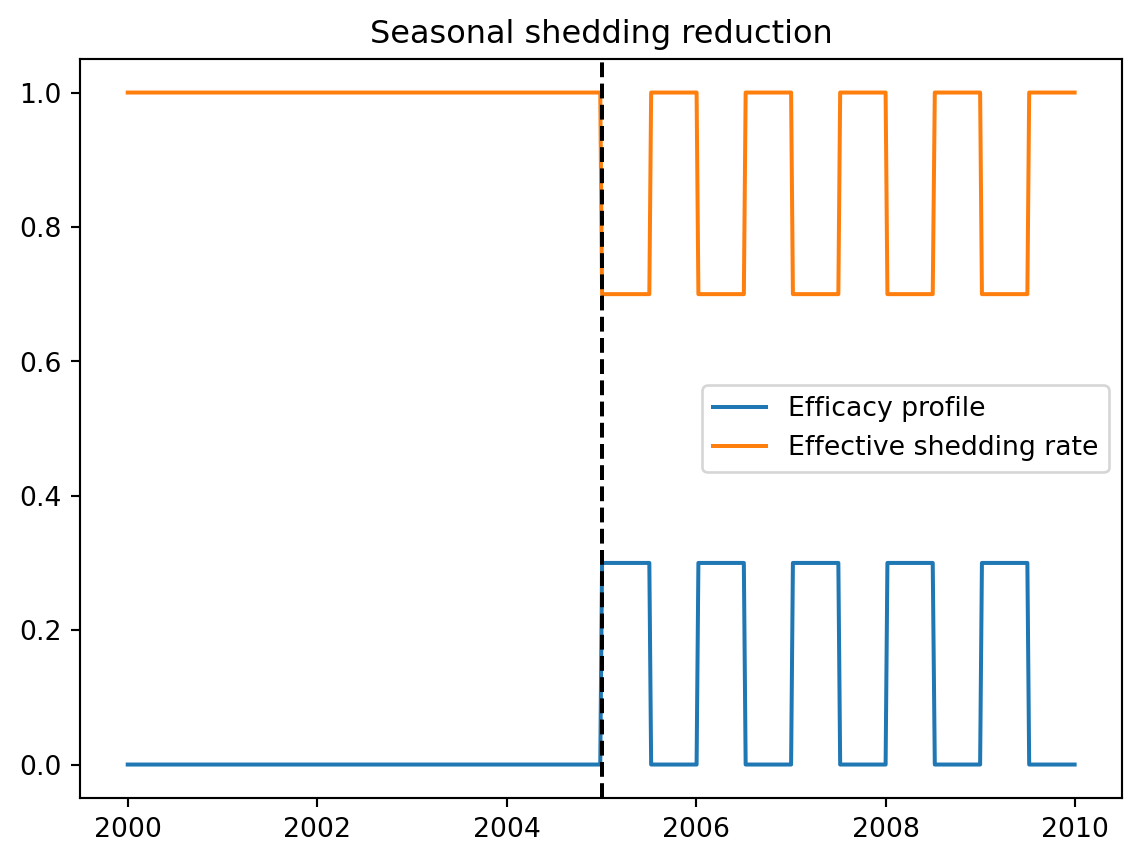
Attenuate the level of exposure by reducing the shedding rate into the environment
import starsim as ssimport typhoidsim as ty# Define high-level simulation parameterspars =dict( start =2000, # Starting year dur =10.0, # Duration of the simulation in years dt =7.0/365.0, # Timestep of 1 week, expressed in years verbose =0, # Do not print details of the run)# The populationppl = ss.People(50_000)# The disease, with reduced protection per infection `tppi`,# initial typhoid prevalence `init_prev`, and preexisting# population immunity `init_seroprev`typhoid = ty.Typhoid(pars={'tppi':0.1, 'init_seroprev':0.8, 'init_prev':0.001})# The environment (long cycle CCVT)environment = ty.EnvironmentalPool()# Modulates the level of CFUs in the environment by reducing the shedding rate from people to the environment,# Use a periodic rectangular pulsesanitation_efficacy = ty.Pattern("(var % period < width) * max_efficacy", pars={'period': 1.0, # in years'width' : 0.5, # in years'max_efficacy': 0.3} # peak shedding reduction (0-1) )sanitation = ty.shedding_reduction(efficacy=sanitation_efficacy, start_year=2005)sim = ss.Sim( pars=pars, people=ppl, diseases=typhoid, demographics=environment, interventions=sanitation )sim.run()sim.plot(key=('environmentalpool_cfu_conc'))