import starsim as ss

S, E, I, R = ss.states('S E I R')
infection   = S >> E @ 0.16*I
progression = E >> I @ ss.days(10)
recovery    = I >> R @ ss.days(8)
cases       = ss.outcome(0.4*infection)
measles = ss.Disease(infection, progression, recovery, cases,
    init = dict(R=ss.by(age=[0.8, 0.92, 0.98])),
    init_n = dict(I=10),
    name = 'measles',
)
measles.stratify(age={0: 0.3, 15: 0.6, 65: 0.1})
contacts = ss.contacts(ages=[0, 15, 65], matrix=[[10, 6, 1], [3, 8, 1], [3, 6, 3]])
settings = dict(networks=contacts, total_pop=100_000, start='2025-01-01', stop='2026-01-01', verbose=0)

class VaccineDemand(ss.Intervention):
    """ Unvaccinated people seek vaccination at a rate that rises with the outbreak cases they remember """

    def __init__(self, memory=ss.days(30), half=300, max_rate=ss.perweek(0.1), capacity=None, efficacy=0.93, **kwargs):
        super().__init__()
        self.define_pars(memory=memory, half=half, max_rate=max_rate, capacity=capacity, efficacy=efficacy)
        self.update_pars(**kwargs)
        self.remembered = 0.0
        return

    def init_results(self):
        super().init_results()
        self.define_results(
            ss.Result('doses', kind='flow', scale=False, label='Doses given'),
            ss.Result('remembered', kind='stock', scale=False, label='Cases remembered'),
        )
        return

    def step(self):
        measles = self.sim.diseases.measles
        dt = self.t.dt
        new_cases = self.sim.results.measles.cases[self.ti-1] if self.ti > 0 else 0
        self.remembered += new_cases - self.remembered*(dt/self.pars.memory)
        frac = self.remembered/(self.remembered + self.pars.half)
        doses = (self.pars.max_rate*frac).to_prob(dt)*measles.S.n
        if self.pars.capacity is not None:
            doses = min(doses, self.pars.capacity.to_events(dt))
        ss.move(measles.S, measles.R, n=doses*self.pars.efficacy)
        self.results.doses[self.ti] = doses
        self.results.remembered[self.ti] = self.remembered
returnSolutions: T8 – Custom modules
These are solutions to the exercises of T8 – Custom modules. Many exercises are open-ended, so these are examples: there are often other good answers.
Vaccine demand (exercises 1–3)
Exercises 1 to 3 use the measles model and the VaccineDemand class of the tutorial’s module as a class, copied unchanged:
1. How long people remember.
baseline = ss.Sim(measles, **settings).run().results.measles.infection.sum()
sims = {str(days) + ' days': ss.Sim(measles, interventions=VaccineDemand(memory=ss.days(days)), **settings) for days in [10, 30, 90]}
msim = ss.parallel(sims)
for sim in msim.sims:
    res = sim.results
    doses = res.vaccinedemand.doses.sum()
    prevented = baseline - res.measles.infection.sum()
    print('Memory of', sim.label, '- doses:', round(doses), '- infections prevented:', round(prevented), '- per dose:', round(prevented/doses, 2))
Memory of 10 days - doses: 3454 - infections prevented: 3104 - per dose: 0.9
Memory of 30 days - doses: 4916 - infections prevented: 3961 - per dose: 0.81
Memory of 90 days - doses: 6094 - infections prevented: 4342 - per dose: 0.71The longer people remember, the more doses are sought (about 3,500 with a memory of 10 days, 4,900 with 30, and 6,100 with 90), and the more infections are prevented (about 3,100, 4,000, and 4,300). But each extra dose prevents fewer: about 0.9 infections a dose with a memory of 10 days, and 0.7 with 90. A longer memory adds doses mostly after the peak, when most of those the outbreak would infect already have been, so a dose then protects someone unlikely to be infected anyway.
2. Avoiding contact as well.
def avoidance(sim):
    """ Susceptibility falls by up to 30% as people remember more cases """
    demand = sim.interventions.vaccinedemand
    frac = demand.remembered/(demand.remembered + demand.pars.half) # The fraction used for demand
    return 1 - 0.3*frac

sims = {
    'Vaccine demand':               ss.Sim(measles, interventions=VaccineDemand(), **settings),
    'Vaccine demand and avoidance': ss.Sim(measles, interventions=[VaccineDemand(), ss.modify(measles.rel_sus, multiply=avoidance)], **settings),
}
msim = ss.parallel(sims)
msim.plot('measles.I')
msim.summarize().loc['measles_infection']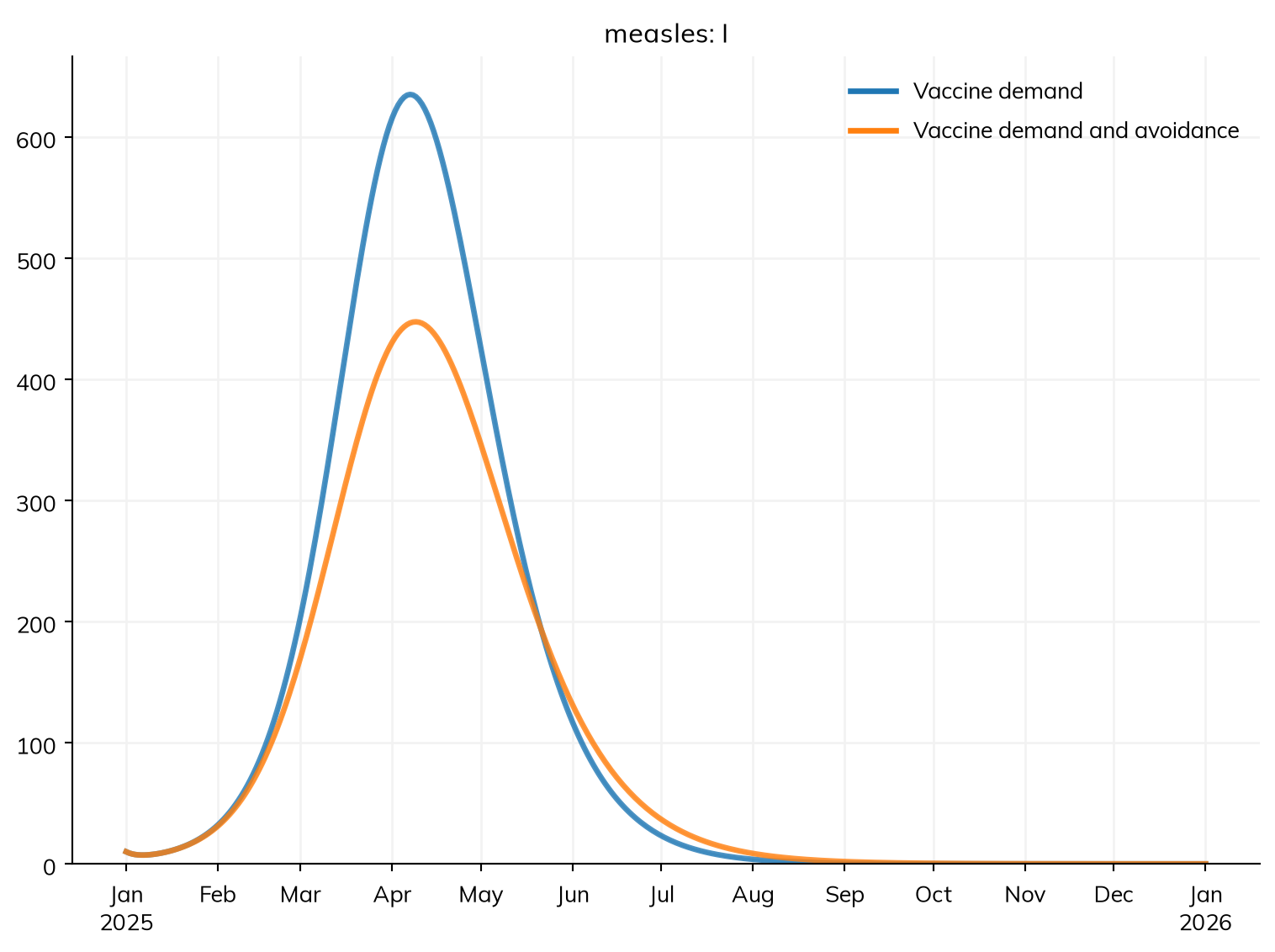
| value | |
|---|---|
| scenario | |
| Vaccine demand | 5,397 |
| Vaccine demand and avoidance | 4,397 |
Avoiding contact makes the outbreak about a fifth smaller again (about 4,400 infections rather than 5,400). The function reads the module from the sim (sim.interventions.vaccinedemand), not a variable outside it, since the sim works on its own copy; and since neither the module nor the modifier keeps anything for each person, the sim still runs as an ODE.
3. As agents.
sims = {
    'ODE':    ss.Sim(measles, interventions=VaccineDemand(), **settings),
    'Agents': ss.Sim(measles, interventions=VaccineDemand(), n_agents=100_000, **settings),
}
msim = ss.parallel(sims)
for sim in msim.sims:
    res = sim.results
    print(sim.label, f'({sim.solver}) - infections:', round(res.measles.infection.sum()), '- doses:', round(res.vaccinedemand.doses.sum()))
ODE (ode) - infections: 5397 - doses: 4916
Agents (abm) - infections: 5388 - doses: 4917The module runs unchanged as agents, and the two agree to within a few percent (agents vary a little from run to run). It needs no change because it uses only what works under every solver: a result of the sim (cases), the number of people in a state (measles.S.n), and ss.move() with a number of people, which as agents moves that many randomly chosen agents from S to R. A module that picked out particular people, e.g. with measles.S.uids, would run only as agents (as in the tutorial’s section on a value for each person).
A value for each person (exercise 4)
4. The half-life of the antibodies. This uses the cold and the Antibodies class of the tutorial’s section on a value for each person, copied without its results, which the answer doesn’t need:
import numpy as np

class Antibodies(ss.Module):
    """ Each person's antibody level: boosted by each recovery, up to 1, and halving every half_life in between """
    def __init__(self, half_life=ss.days(90), boost=0.5, **kwargs):
        super().__init__()
        self.define_pars(half_life=half_life, boost=boost)
        self.update_pars(**kwargs)
        self.define_states(ss.FloatArr('level', default=0.0, label='Antibody level'))
        return

    def step(self):
        self.level[:] = self.level*0.5**(self.t.dt/self.pars.half_life)
        recovered = self.sim.diseases.cold.recovery.uids
        self.level[recovered] = np.minimum(1.0, self.level[recovered] + self.pars.boost)
        return

S, I = ss.states('S I')
cold = ss.Disease(infection=S >> I @ 0.4*I, recovery=I >> S @ ss.days(7), init_prev=0.01, name='cold')
pars = dict(networks=ss.MixingPool(n_contacts=1), n_agents=10_000, stop=ss.days(2*365), verbose=0)

def susceptibility(sim):
    """ Each person's susceptibility: 1 minus their antibody level """
    return 1 - sim.custom.antibodies.level

protection = ss.modify(cold.rel_sus, multiply=susceptibility)
variants = {
    'Half-life of 30 days':        dict(half_life=ss.days(30)),
    'Half-life of 90 days':        dict(),
    'Half-life of 365 days':       dict(half_life=ss.days(365)),
    'Half-life of 90 days, boost of 1': dict(boost=1.0),
}
sims = {'No immunity': ss.Sim(cold, **pars)}
for label, kwargs in variants.items():
    sims[label] = ss.Sim(cold, Antibodies(**kwargs), connectors=protection, **pars)
msim = ss.parallel(sims)
msim.plot('cold.I')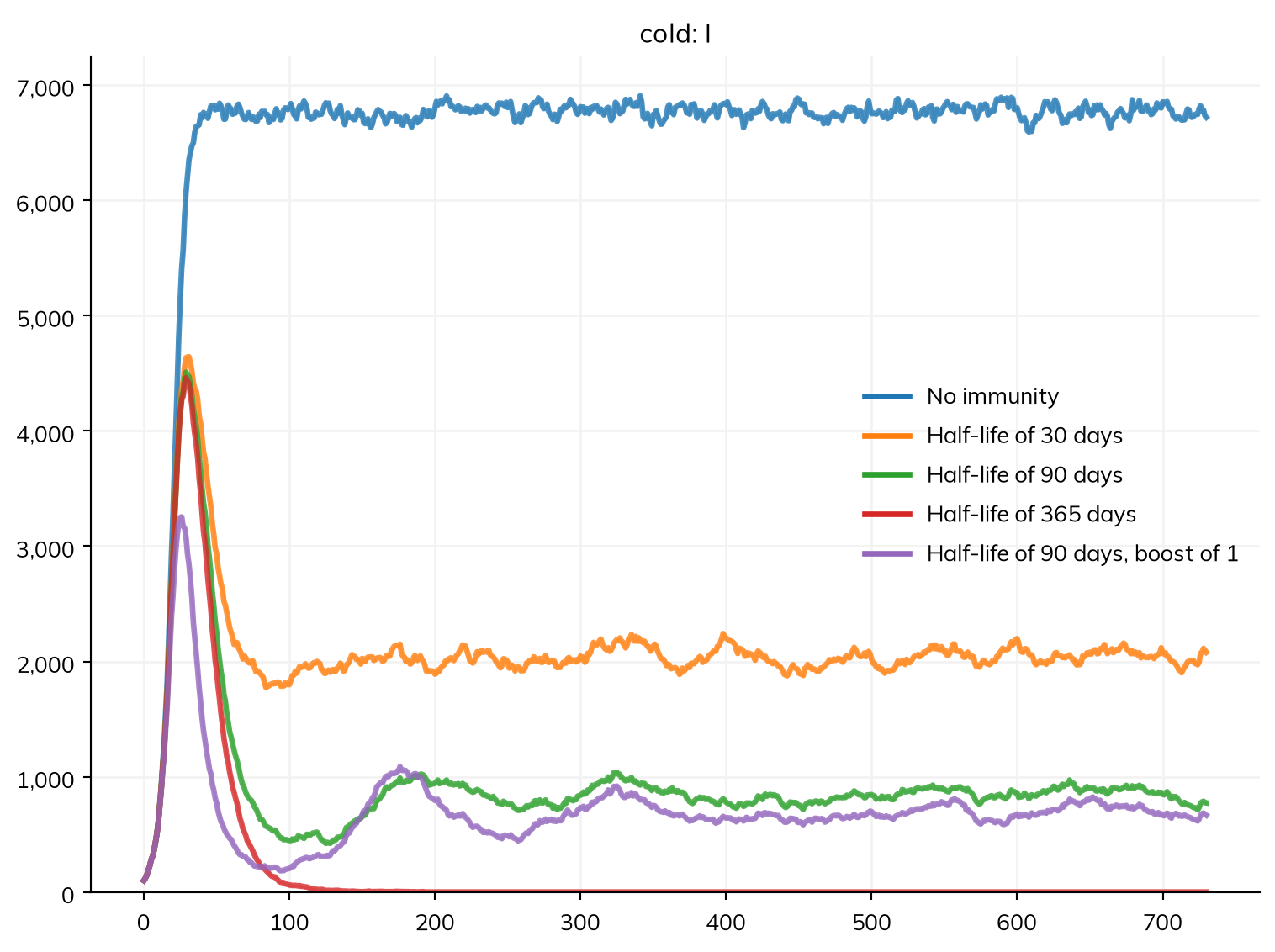
The longer the antibodies last, the lower the endemic level. With a half-life of 30 days, people regain most of their susceptibility within a couple of months, so the infection settles at about 30% of its level with no immunity; with 90 days, at about an eighth. With a half-life of a year, protection builds up faster than it fades, and the infection dies out after the first wave. With a boost of 1, every recovery restores full protection, so the level depends only on the time since the last recovery: this is the declared form of the tutorial (1 - 0.5**(cold.recovery.since/ss.days(90))), and gives a smaller first wave than a boost of 0.5, then much the same endemic level.
Advanced: a disease written as code (exercise 5)
5. Losing immunity with a constant chance each step. This changes the SIRS class of the tutorial’s section on a disease written as code. Rather than copy it, subclass the template again, replacing only step_state() (with no waning time to schedule, set_progression() stays as it is in ssl.AgentSIR). A constant chance each step gives an exponential (or, in whole steps, geometric) duration of immunity, with the same mean as ss.expon(mean=ss.days(180)) if the chance per day is 1/180, so the waning works the same way, and the epidemic is the same up to chance:
import starsim.library as ssl

class SIRS(ssl.AgentSIR):
    def __init__(self, pars=None, *args, **kwargs):
        super().__init__()
        self.define_pars(p_wane=ss.bernoulli(p=1/180)) # The chance of losing immunity each day
        self.update_pars(pars, **kwargs)
        return

    def step_state(self):
        super().step_state()
        waning = self.pars.p_wane.filter(self.recovered.uids) # Each recovered agent loses immunity with this chance
        self.recovered[waning] = False
        self.susceptible[waning] = True
        return

coded = SIRS(beta=ss.perday(0.4), dur_inf=ss.expon(mean=ss.days(7)), p_death=0, init_prev=0.01, name='cold')
sim = ss.Sim(coded, networks=ss.MixingPool(n_contacts=1), n_agents=10_000, stop=ss.days(2*365), dt=ss.days(1), verbose=0)
sim.run()
sim.results.cold.infected.plot()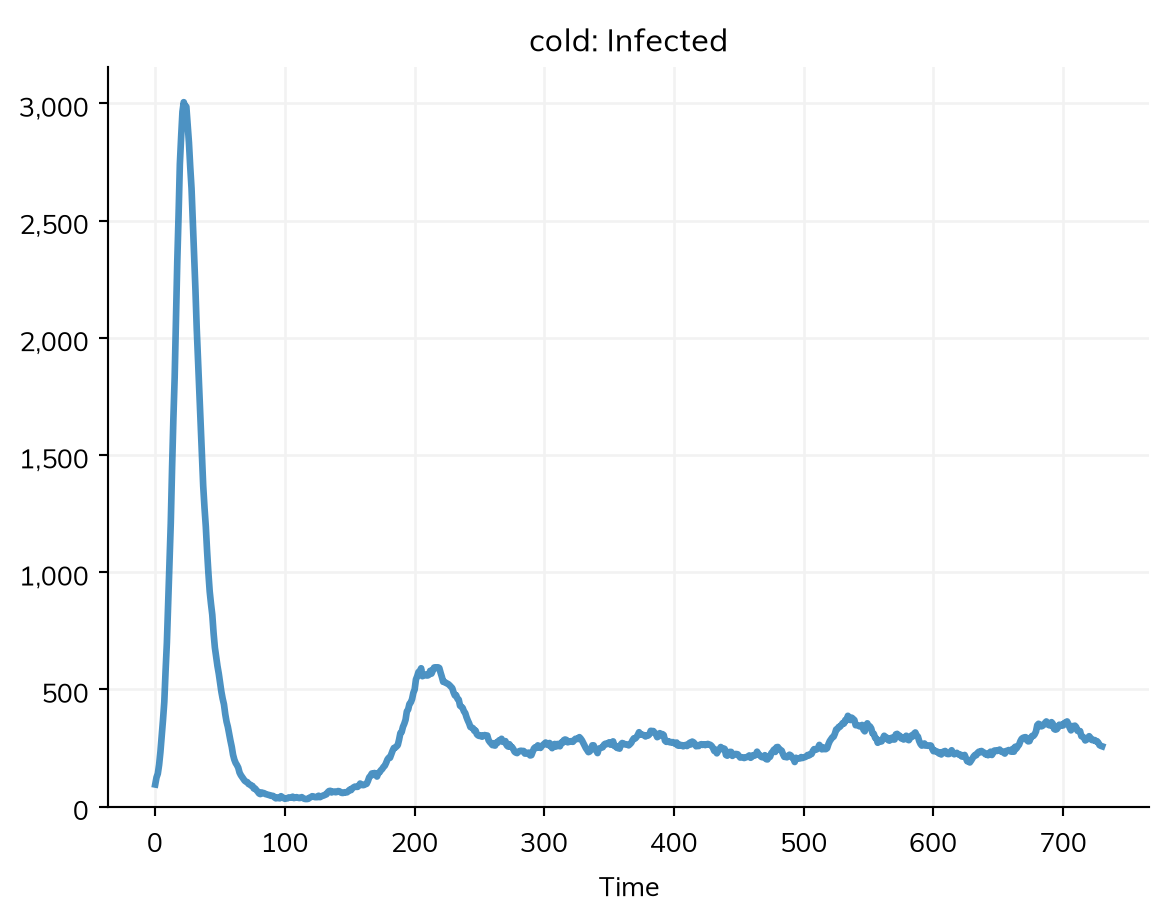
The chance is per step, so it is only right for a step of one day; a version that works for any step would convert a rate to a chance per step (e.g. ss.peryear(2).to_prob()), or schedule the time of waning at recovery, as the tutorial’s version does.
Advanced: a network written as code (exercise 6)
6. Some contacts at random. This uses the AgeNet class of the tutorial’s section on a network written as code, copied unchanged. The simplest way is to keep it as it is, and add a random network beside it, splitting the 4 contacts a day between the two:
class AgeNet(ss.Network):
    """ Contacts each day with people close in age """
    def __init__(self, n_contacts=4, spread=ss.years(2), **kwargs):
        super().__init__()
        self.define_pars(n_contacts=n_contacts, spread=spread)
        self.update_pars(**kwargs)
        self.noise = ss.normal(0, 1)
        return

    def add_pairs(self):
        uids = self.sim.people.alive.uids
        age = self.sim.people.age[uids] + self.pars.spread.years*self.noise.rvs(uids)
        order = uids[np.argsort(age, kind='stable')]
        p1 = np.concatenate([order[:-k] for k in range(1, self.pars.n_contacts//2 + 1)])
        p2 = np.concatenate([order[k:] for k in range(1, self.pars.n_contacts//2 + 1)])
        self.append(p1=p1, p2=p2, weight=np.ones(len(p1)))
        return

    def step(self):
        self.remove_edges(np.ones(len(self), dtype=bool))
        self.add_pairs()
        return

S, I, R = ss.states('S I R')
cold = ss.Disease(infection=S >> I @ 0.1*I, recovery=I >> R @ ss.days(7), init_prev=0.001, name='cold')

pars = dict(n_agents=5000, stop=ss.days(250), verbose=0)
sims = {
    'All random':           ss.Sim(cold, networks=ss.RandomNet(n_contacts=4), **pars),
    'All close in age':     ss.Sim(cold, networks=AgeNet(n_contacts=4), **pars),
    'Half at random':       ss.Sim(cold, networks=[AgeNet(n_contacts=2), ss.RandomNet(n_contacts=2)], **pars),
}
msim = ss.parallel(sims)
msim.plot('cold.I')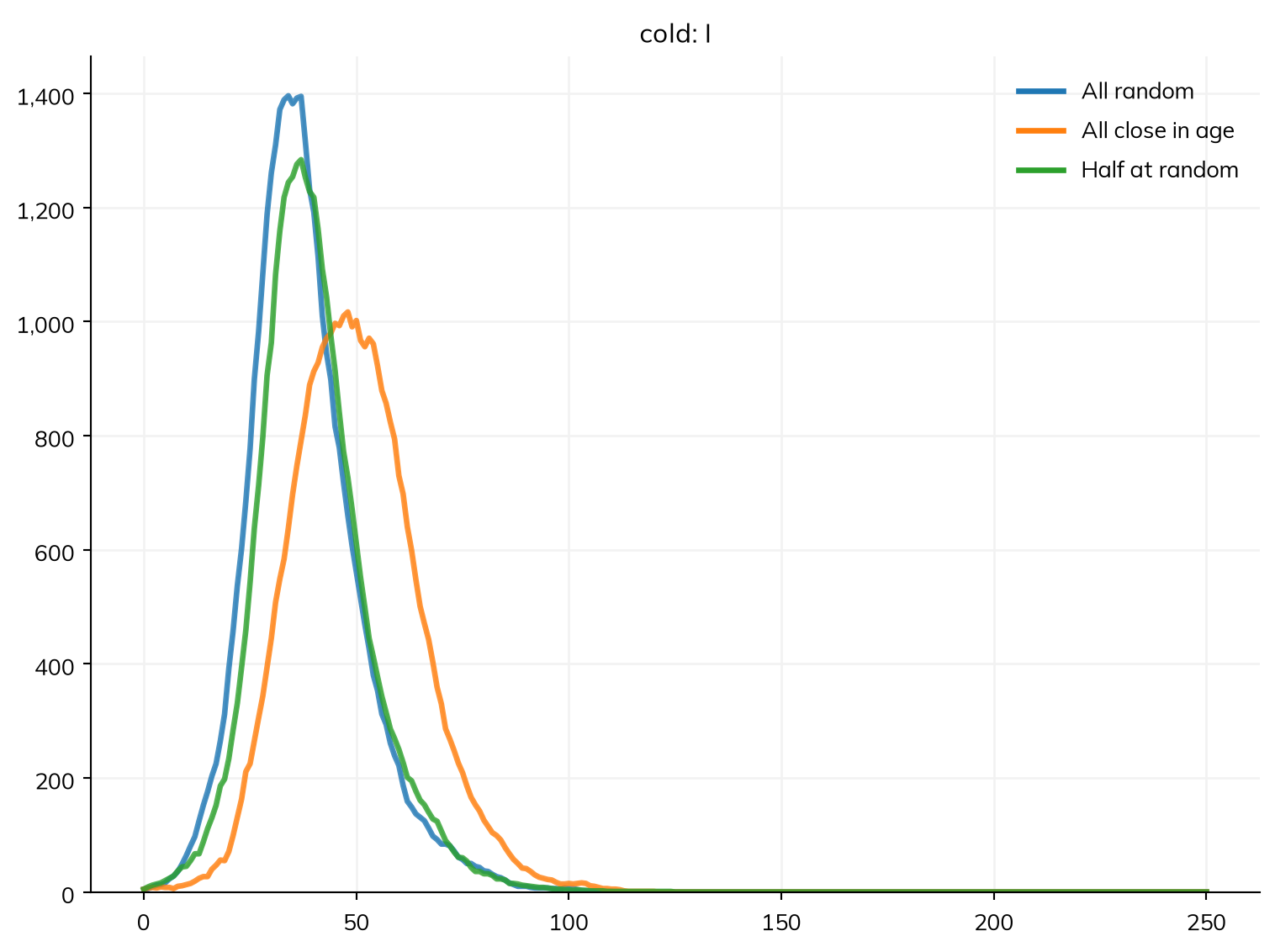
With half of the 4 contacts at random, the epidemic is almost the same as with all contacts random: a few long-range contacts are enough to carry the infection across the ages, as in a “small-world” network. (AgeNet pairs each person with an even number of neighbors, so to try smaller fractions, give it more contacts and the random network fewer, keeping the total the same, e.g. 6 and 2, and compare with 8 contacts all at random.)