import numpy as np
import starsim as ss

S, I = ss.states('S I')
infection = S >> I @ ss.peryear(2)*I  # β = 2 per year
recovery  = I >> S @ ss.years(1)      # Infected for a year on average, then susceptible again
sis = ss.Disease(infection, recovery, init_prev=0.1)

kw = dict(n_agents=5000, start=2000, stop=2020, dt=ss.months(1), verbose=0)Products
Vaccination, screening, and treatment programs have two parts: what is given (a vaccine, a test, or a drug: a product), and the delivery, which says who gets it, when, and how many. Starsim keeps the two apart, so the same vaccine can be given routinely in one scenario and in a campaign in another. This page covers products; deliveries, and changes to parameters that need no product, are on Interventions, and costs on Health economics. The tutorial T5 – Interventions and scenarios uses a vaccine for measles, and then tests and treatment (Advanced: interventions as agents).
| Product | Delivered by | Main keywords |
|---|---|---|
ss.Vaccine |
ss.vaccinate() |
efficacy, waning, leaky, doses, during, cost |
ss.Diagnostic |
ss.screen() |
sensitivity, specificity, result_delay, detects, outcomes, cost |
ss.Treatment |
ss.treat() |
cure, efficacy, transition, waning, during, cost |
Each delivery (ss.vaccinate(), ss.screen(), ss.treat()) takes the product’s own keywords and makes the product, or takes a product made explicitly, as where one product is given by several deliveries (see below). Name a delivery after the activity (vaccination, screening), since the product takes the name of the thing (vaccine, test). Every keyword of each product is in the appendix.
Products run under every solver, but what follows each person’s own history needs agents, and a compartmental run approximates some waning shapes (see What needs agents); for any waning shape under every solver, write the protection as states of the disease, and move people into them with an event (see Interventions).
The examples on this page use a curable infection with no lasting immunity, as an SIS model run as agents:
Vaccines
A vaccine’s efficacy is its protection against infection: the chance of infection of everyone who holds it is multiplied by 1 − efficacy. A dict gives efficacy against infectiousness, death, any transition, several diseases, or each strain (see the appendix).
By default a vaccine is leaky: everyone vaccinated is partly protected. With leaky=False it is all or nothing: a fraction efficacy of those vaccinated are fully protected, and the rest not at all. waning= is how protection fades: a duration means it is lost after an exponentially distributed time with that mean. Here are all three, given to half of people in 2010:
kw_vx = dict(coverage=0.5, when='2010')
scenarios = {
    'No vaccine':                     ss.Sim(sis, **kw),
    'Leaky (80%)':                    ss.Sim(sis, interventions=ss.vaccinate(efficacy=0.8, **kw_vx), **kw),
    'All or nothing (80%)':           ss.Sim(sis, interventions=ss.vaccinate(efficacy=0.8, leaky=False, **kw_vx), **kw),
    'Leaky, waning after 3 years':    ss.Sim(sis, interventions=ss.vaccinate(efficacy=0.8, waning=ss.years(3), **kw_vx), **kw),
}
msim = ss.parallel(scenarios)
msim.plot('sis.I')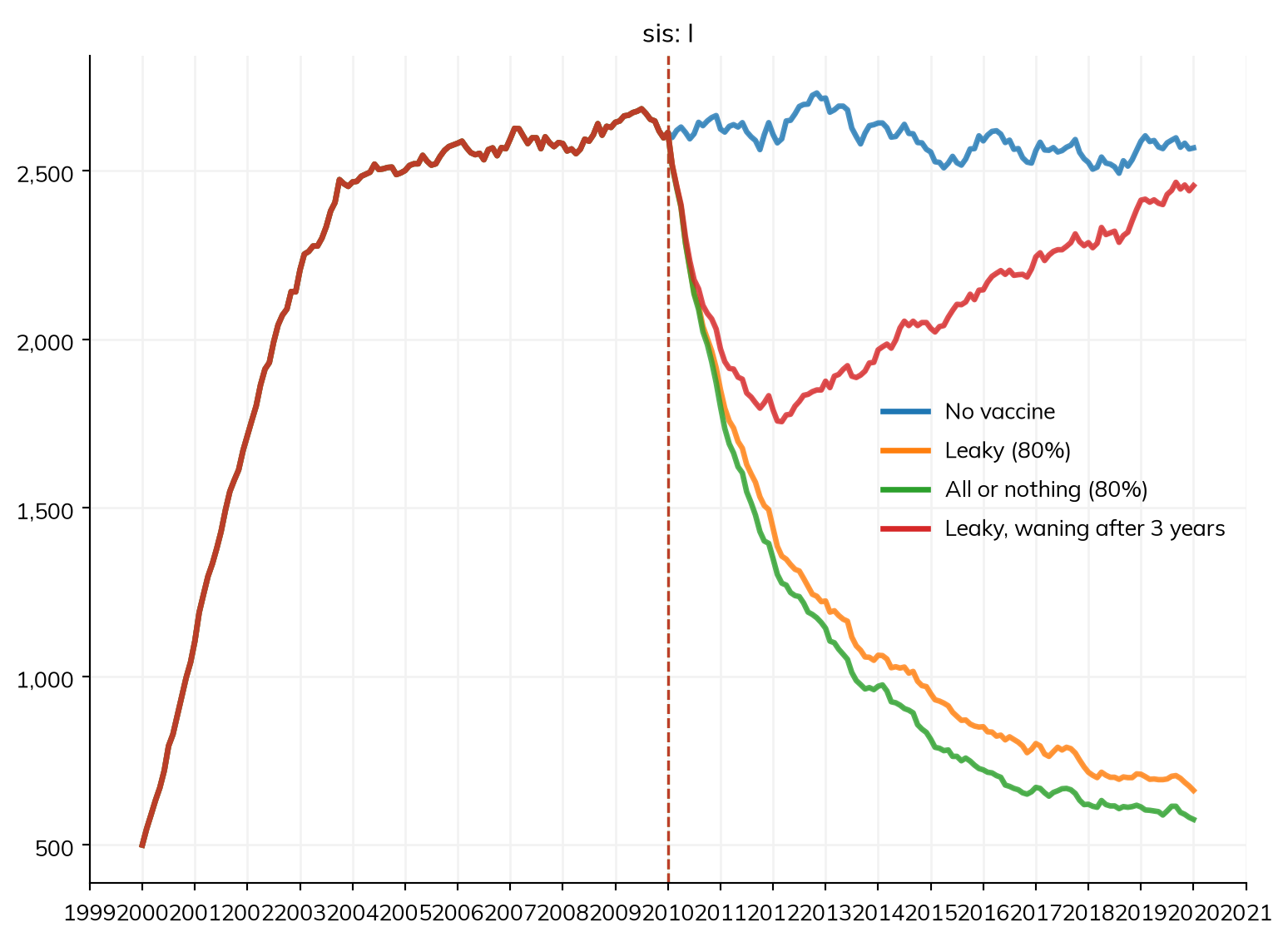
doses=[0.85, 1.0] gives a vaccine in doses, with the fraction of the full protection after each; each delivery to someone who already holds the vaccine gives the next dose.
Protection can also fade by its own shape. ss.boxcar(plateau=..., decay=...) is full protection for plateau, then (with decay=) an exponential decline with that mean. Agents follow it exactly; a compartmental run approximates the plateau by a series of levels, each left at a rate, so its end is spread out (stages= sets how many), and says so in a note. Any other shape is a function of the time since delivery, t (a duration, so t.years works in any sim), returning the fraction of protection left; a function of (t, sim, uids) also gets the sim and the people who hold it. A function runs as agents only.
scenarios = {
    'Plateau of 2 years, then a decline': ss.Sim(sis, interventions=ss.vaccinate(efficacy=0.8, waning=ss.boxcar(plateau=ss.years(2), decay=ss.years(3)), **kw_vx), **kw),
    'Fading linearly over 5 years':   ss.Sim(sis, interventions=ss.vaccinate(efficacy=0.8, waning=lambda t: np.clip(1 - t.years/5, 0, 1), **kw_vx), **kw),
}
msim = ss.parallel(scenarios)
msim.plot('sis.I')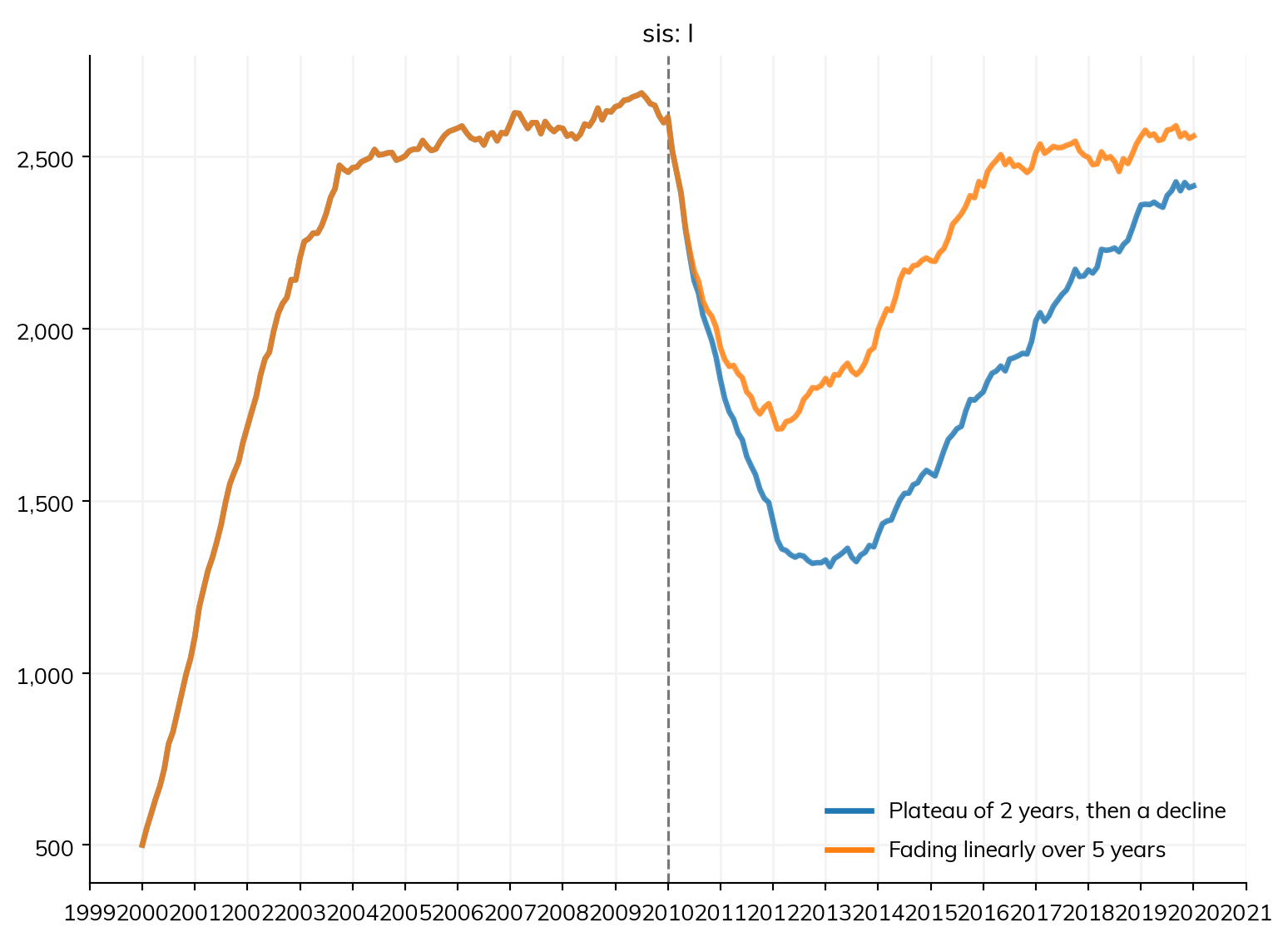
during= holds a product only while people are in some states: ss.Treatment(efficacy=dict(transmission=0.5), during=sis.I) makes people half as infectious while they are infected, and they stop holding it when they recover.
The fraction of people holding a product is also a quantity a rate can read: itn.held_frac is the fraction of the people in the same place who hold it, each counted by the protection they have left, and itn.held_frac(fn) counts each by a function of the time since delivery (e.g. the fraction of mosquitoes a net kills). A disease made with the product can use it in any rate, e.g. Sv >> ss.dead @ 1/life + a*kill*itn.held_frac.
One product, several deliveries
A product made on its own can be given by several deliveries, which then share it: a person vaccinated by either holds the same vaccine, and is not protected twice, and a delivery skips people who already hold its product (unless the product fades by a shape or a function, when a new dose restarts it). Here a vaccine is given routinely to children as they turn one, and in a campaign in 2010, either of the same vaccine or of a vaccine of its own, so that a child reached by both holds two:
kw_births = dict(kw, demographics=[ss.birth(rate=ss.peryear(0.03)), ss.death(rate=ss.peryear(0.03))])

vaccine  = ss.Vaccine(efficacy=0.8)
routine  = ss.vaccinate(vaccine, who=ss.at_age(ss.years(1)), start='2005', coverage=0.8)
campaign = ss.vaccinate(vaccine, when=['2010'], coverage=0.5)
separate = ss.vaccinate(efficacy=0.8, when=['2010'], coverage=0.5, name='campaign') # Makes a second vaccine

scenarios = {
    'No vaccination':                     ss.Sim(sis, **kw_births),
    'Routine':                            ss.Sim(sis, interventions=routine, **kw_births),
    'Routine and campaign, one vaccine':  ss.Sim(sis, interventions=[routine, campaign], **kw_births),
    'Routine and campaign, two vaccines': ss.Sim(sis, interventions=[routine, separate], **kw_births),
}
msim = ss.parallel(scenarios)
msim.plot('sis.I')
for sim in msim.sims[2:]:
    print(sim.label, '- doses in the campaign:', round(sim.results.campaign.delivered.sum()), '- routine doses:', round(sim.results.routine.delivered.sum()))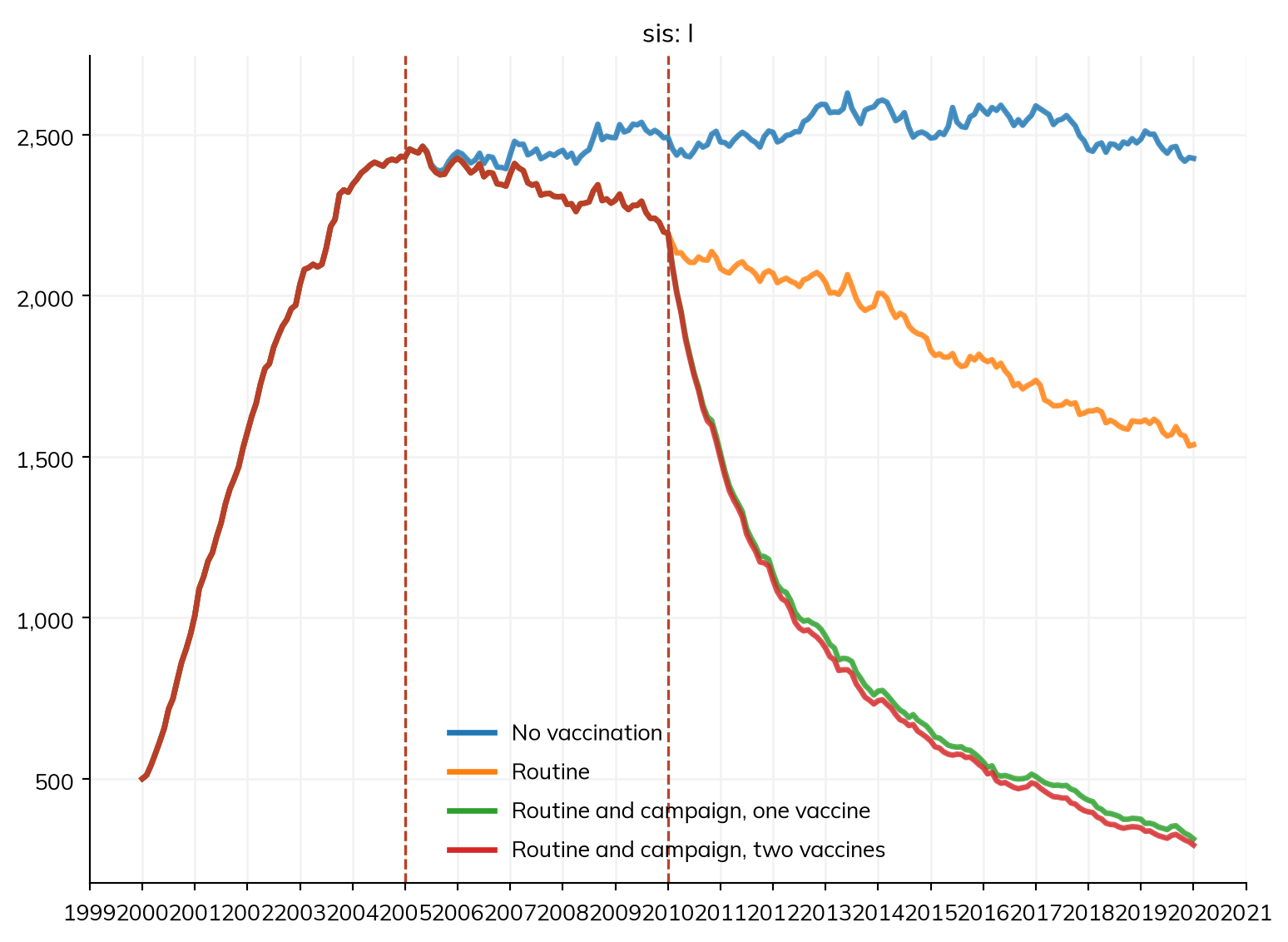
Routine and campaign, one vaccine - doses in the campaign: 2183 - routine doses: 1693
Routine and campaign, two vaccines - doses in the campaign: 2456 - routine doses: 1751
Tests and what follows them
A test (ss.Diagnostic) has a sensitivity, the chance that someone infected tests positive, and a specificity, the chance that someone not infected tests negative. ss.screen() delivers it, and its positive and negative are the people with each result on that step. What happens to them is another delivery, triggered by when=screening.positive, with its own coverage, so loss to follow-up is explicit. Here half of people are screened each year from 2010, and 80% of those who test positive are treated with a drug that cures 95%. The “Explicit” tab makes the test and the drug as products first, and gives them to the deliveries, which is what the keywords do:
screening = ss.screen(sensitivity=0.9, specificity=0.98, when=ss.schedule(every=ss.years(1), start='2010'), coverage=0.5)
treatment = ss.treat(cure=0.95, when=screening.positive, coverage=0.8)

sim = ss.Sim(sis, interventions=[screening, treatment], **kw)
sim.run()
sim.plot('sis')
print('Positive tests:', sim.results.screening.positive.sum())
print('Treated:', sim.results.treatment.delivered.sum())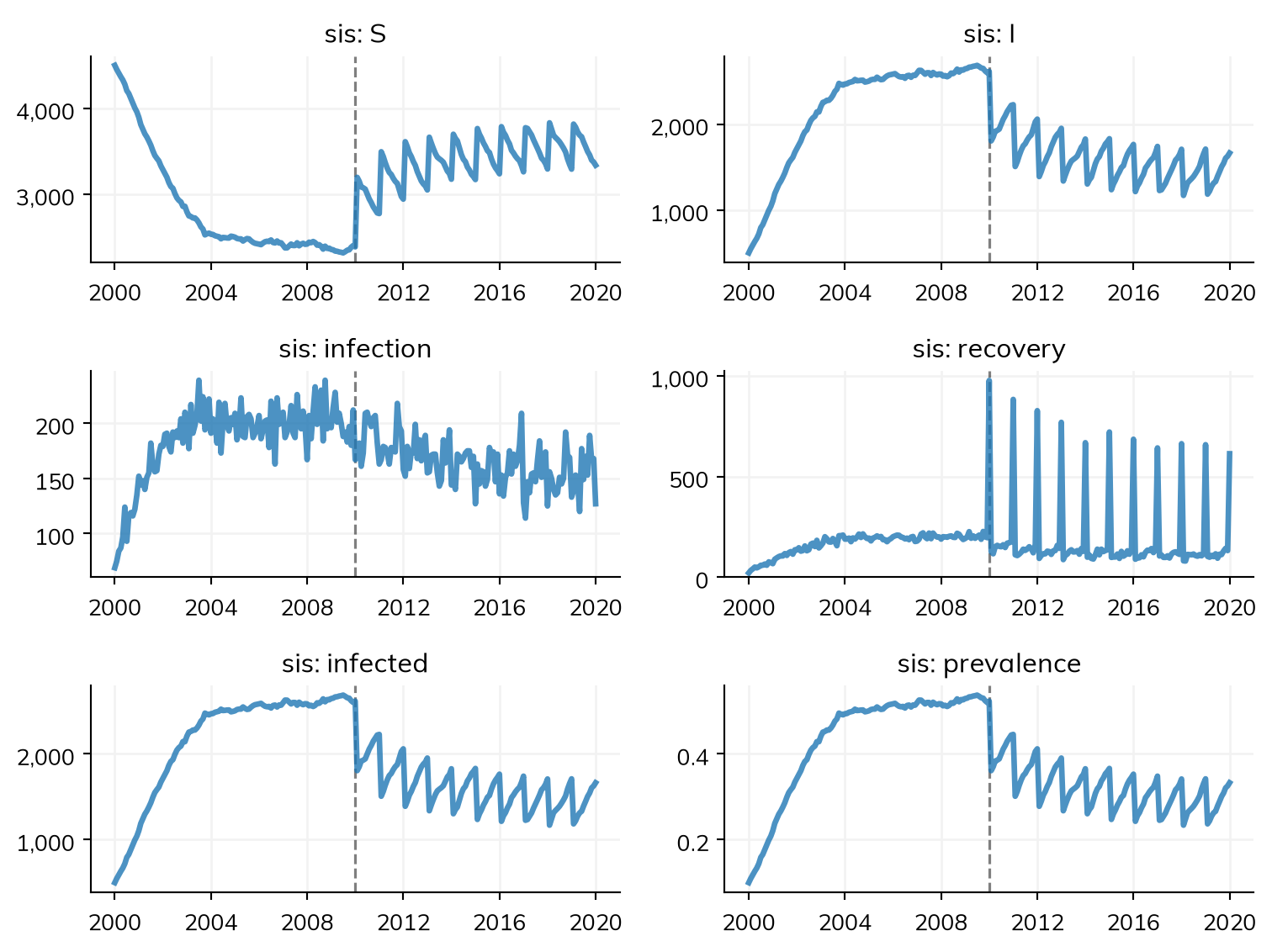
Positive tests: 9654.0
Treated: 7665.0library(starsim)
# The SIS model above
states("S I")
infection <- Transition(S, I, rate = ss$peryear(2) * I) # β = 2 per year
recovery <- Transition(I, S, dur = years(1)) # Infected for a year on average, then susceptible again
sis <- Disease(infection, recovery, init_prev = 0.1)
screening <- ss$screen(sensitivity = 0.9, specificity = 0.98, when = ss$schedule(every = years(1), start = "2010"), coverage = 0.5)
treatment <- ss$treat(cure = 0.95, when = screening$positive, coverage = 0.8)
sim <- Sim(sis, interventions = list(screening, treatment), n_agents = 5000, start = 2000, stop = 2020, dt = ss$months(1), verbose = 0)
sim$run()
sim$plot("sis")
cat("Positive tests:", sum(sim$results$screening$positive$values), "\n")
cat("Treated:", sum(sim$results$treatment$delivered$values), "\n")test = ss.Diagnostic(sensitivity=0.9, specificity=0.98) # The product: what the test does
drug = ss.Treatment(cure=0.95)
screening = ss.screen(test, when=ss.schedule(every=ss.years(1), start='2010'), coverage=0.5, name='screening') # The delivery: who gets it, and when
treatment = ss.treat(drug, when=screening.positive, coverage=0.8, name='treatment')
sim = ss.Sim(sis, interventions=[screening, treatment], **kw)
sim.run()
sim.plot('sis')
print('Positive tests:', sim.results.screening.positive.sum())
print('Treated:', sim.results.treatment.delivered.sum())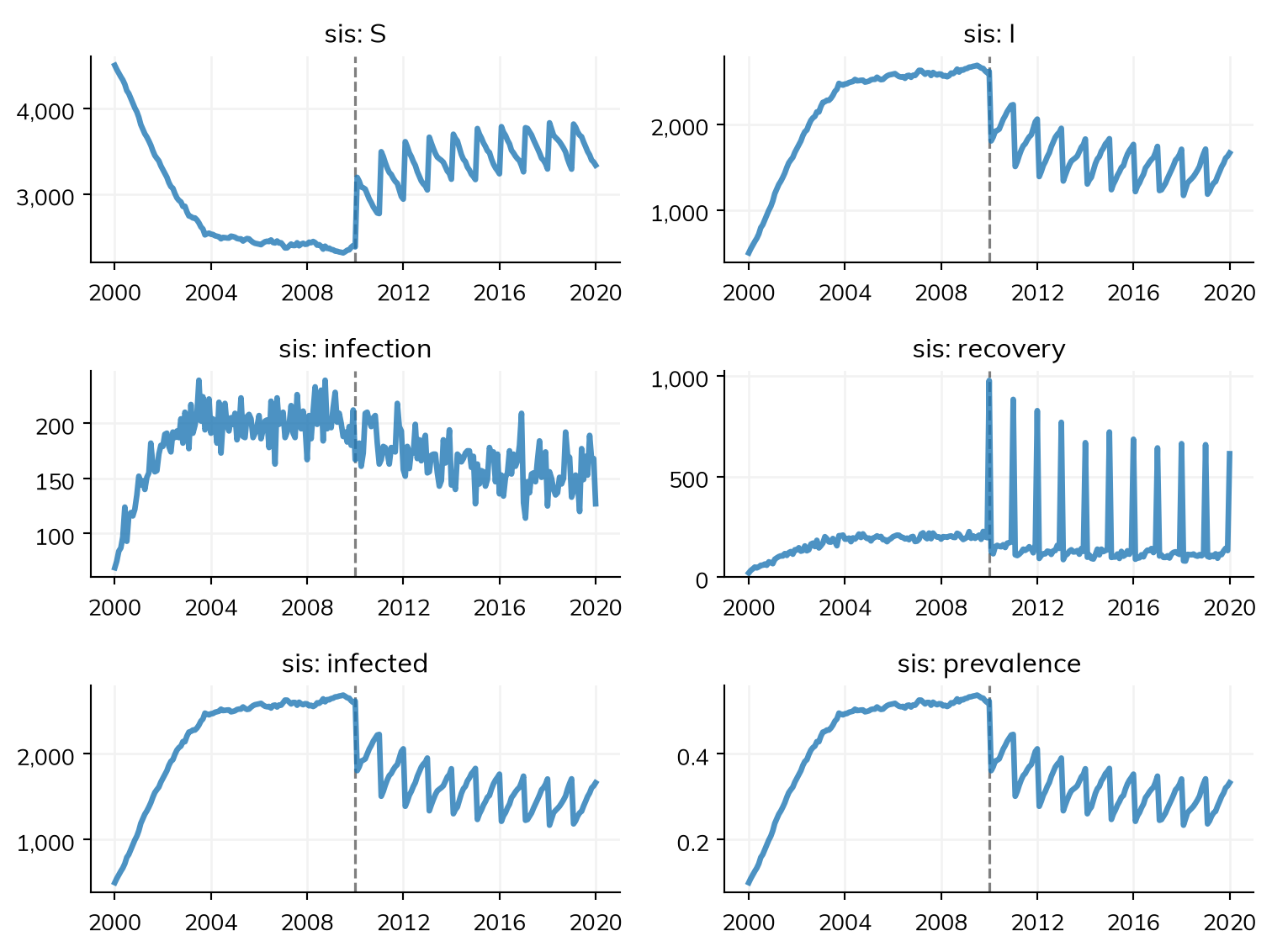
Positive tests: 9654.0
Treated: 7665.0
A follow-up can have follow-ups of its own, to any depth. By default a test detects infection with the disease it is given for; detects= takes a condition for anything else. result_delay= is the time from the test to its result. A test’s values can be by the states of several diseases ({hpv16.I: 0.9, 'hpv18.CIN': 0.95}); with disease=[...], someone is tested once, in the most severe state they are in.
A test can have more than two outcomes: outcomes= gives them, most severe first, each with its chance for people in each state (None for people in none of them), and the last is everyone the others don’t take. Each outcome is a result of the delivery and an event that can trigger what follows:
cytology = ss.Diagnostic(outcomes=dict(high=dict(I=0.9), low={'I': 0.05, None: 0.02}, normal=None)) # Low grade for 2% of those not infected
screening = ss.screen(cytology, when=ss.schedule(every=ss.years(1), start='2010'), coverage=0.5)
treatment = ss.treat(cure=0.8, when=screening.high)

sim = ss.Sim(sis, interventions=[screening, treatment], **kw)
sim.run()
print('High grade:', sim.results.screening.high.sum())
print('Low grade:', sim.results.screening.low.sum())
High grade: 9080.0
Low grade: 829.0Treatments
A treatment’s cure is the chance that it clears the infection, once, when it is given: the person leaves the infected states for the state the disease’s recovery leads to. Its efficacy is what it does for as long as it is held, as for a vaccine: antiretroviral therapy for HIV is efficacy=dict(transmission=0.96, mortality=0.9). A treatment is given to the people who are infected, unless the delivery says otherwise. cure= can be a number (everyone infected), a dict by state (cure=dict(cin=0.9), only those in these states; a disease written as code is cured by its clear_infection()), or a dict by what cured people move along: a transition (cure={tb.cure: 0.9}), or a move written with the states (cure={I + CIN >> S: 0.9}).
Here are the two kinds, each given to infected people at a rate of 50% a year: a cure, and a treatment that cuts how infectious people are by 90% while they are infected:
cure = ss.treat(cure=0.9, coverage=ss.peryear(0.5))
suppress = ss.treat(efficacy=dict(transmission=0.9), during=sis.I, coverage=ss.peryear(0.5))

scenarios = {
    'No treatment':                ss.Sim(sis, **kw),
    'Cure':                        ss.Sim(sis, interventions=cure, **kw),
    'Less infectious while held':  ss.Sim(sis, interventions=suppress, **kw),
}
msim = ss.parallel(scenarios)
msim.plot('sis.I')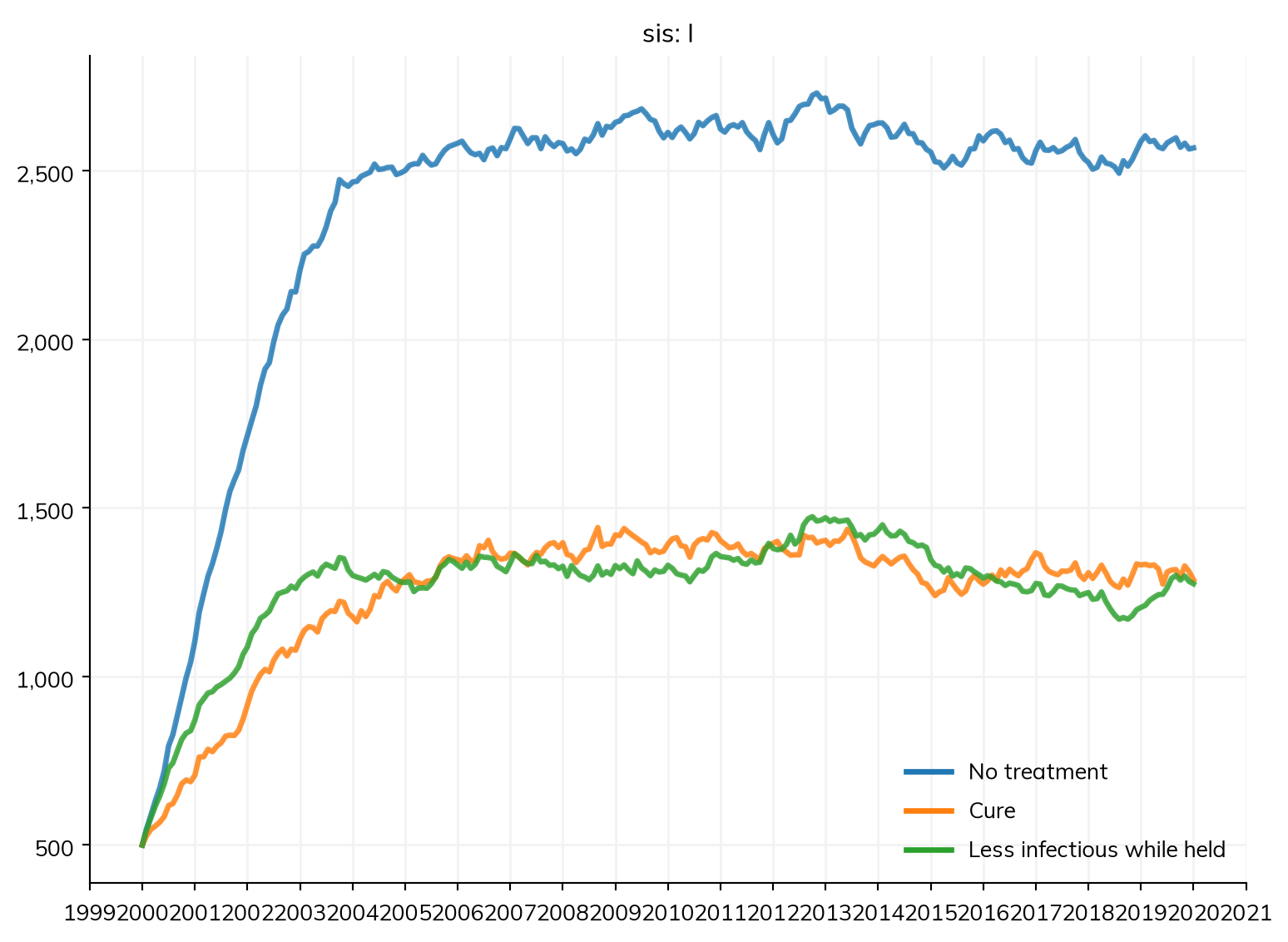
Treatment outcomes and resistance
A treatment that cures has three outcomes on each step, which are results of its delivery and events that can trigger what follows, as a test’s results are: cured, failed (infected, and not cured), and unneeded (given to someone not infected, e.g. after a false positive). ss.treat(..., when=treatment.failed) gives a second-line drug to those the first failed.
A cure keyed by transitions usually names transitions with a rate of 0 (cure = I >> S @ 0), which only treatment drives, each with its own probability: ss.Treatment(cure={syph.cure_early: 0.98, syph.cure_late: 0.95}) cures each stage of syphilis with its own chance, and ss.Treatment(cure={ng.cure: 0.95, ct.cure: 0.95}) is one kit that cures two diseases. moves= names transitions the same way for a treatment that is not a cure, such as starting care (ss.Treatment(moves=hiv.start_art)).
Resistance to a drug is then a transition of the disease, triggered by the drug’s failures. Here a gonorrhea-like infection has a resistant strain (Ir), which arises in 20% of the people the drug fails, and which the drug doesn’t cure:
S, I, Ir = ss.states('S I Ir')
infection     = S >> I  @ ss.peryear(2)*I   # Sensitive infections
infection_res = S >> Ir @ ss.peryear(2)*Ir  # Resistant infections, as transmissible
recovery      = I  >> S @ ss.years(1)
recovery_res  = Ir >> S @ ss.years(1)
cure          = I  >> S @ 0                 # A rate of 0: only treatment moves people along it
drug = ss.Treatment(cure={cure: 0.95})
resistance = ss.Transition(I, Ir, when=drug.failed, p=0.2) # Resistance arises in 20% of failures
ng = ss.Disease(infection, infection_res, recovery, recovery_res, cure, resistance, init_n=dict(I=500), name='ng') # 500 sensitive infections at the start

treatment = ss.treat(drug, start='2005', coverage=ss.peryear(0.5)) # Given to the people in the source of cure, I
sim = ss.Sim(ng, interventions=treatment, n_agents=5000, start=2000, stop=2030, dt=ss.months(1), verbose=0)
sim.run()
sim.plot(['ng.I', 'ng.Ir'])
res = sim.results.treatment
print('Cured:', round(res.cured.sum()), '- failed:', round(res.failed.sum()), '- resistant infections in 2030:', round(sim.results.ng.Ir[-1]))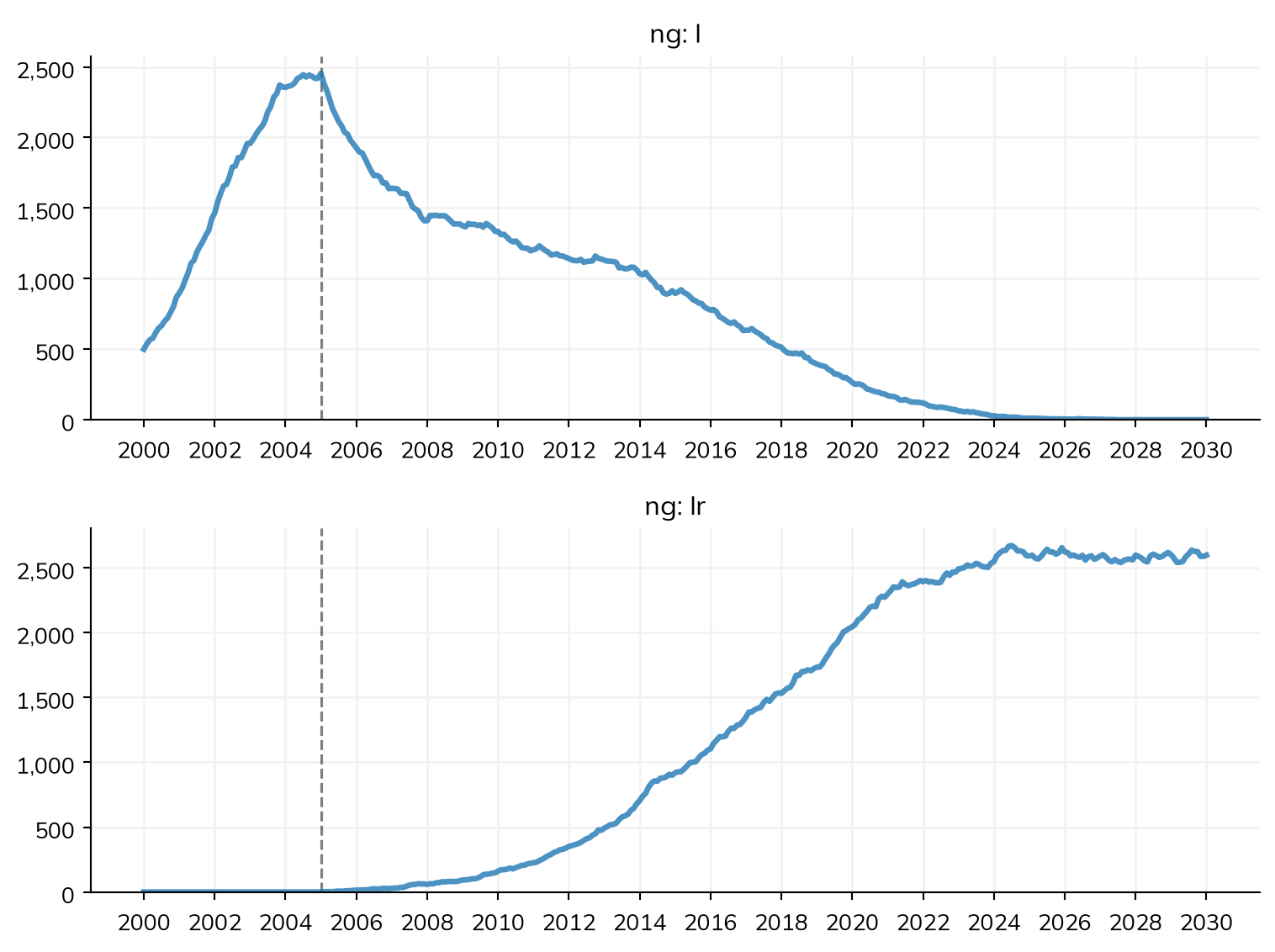
Cured: 8054 - failed: 440 - resistant infections in 2030: 2597A second-line drug (cure={cure_res: 0.9}, triggered by treatment.failed or given to those with Ir) is a second product. Resistance as one of several strains of a disease is on Diseases.
Every product takes cost=, the cost of each delivery, which is then a result of the delivery (cost); see Health economics.
Writing a product as code
A product whose effect needs code of its own is a subclass of ss.Product (or of ss.Vaccine, ss.Diagnostic, or ss.Treatment) with an administer(uids) method, which is called with the people a delivery gave it to on each step. Like any module, it can have parameters of its own (with define_pars()), states, and results. Here is a vaccine that protects younger people more: 90% at birth, falling to none at 80:
class AgeVaccine(ss.Product):
    """ A vaccine whose protection falls with the age at which it is given """
    def __init__(self, efficacy=0.9, **kwargs):
        super().__init__()
        self.define_pars(efficacy=efficacy)
        self.update_pars(**kwargs)
        return

    def administer(self, uids):
        age = self.sim.people.age[uids]
        protection = self.pars.efficacy * np.clip(1 - age/80, 0, 1)
        self.sim.diseases.sis.rel_sus[uids] *= 1 - protection
        return

scenarios = {
    'No vaccine':                    ss.Sim(sis, **kw),
    'Vaccine, 90% at every age':     ss.Sim(sis, interventions=ss.vaccinate(efficacy=0.9, when=['2010'], coverage=0.5), **kw),
    'Vaccine, falling with age':     ss.Sim(sis, interventions=ss.vaccinate(AgeVaccine(), when=['2010'], coverage=0.5), **kw),
}
msim = ss.parallel(scenarios)
msim.plot('sis.I')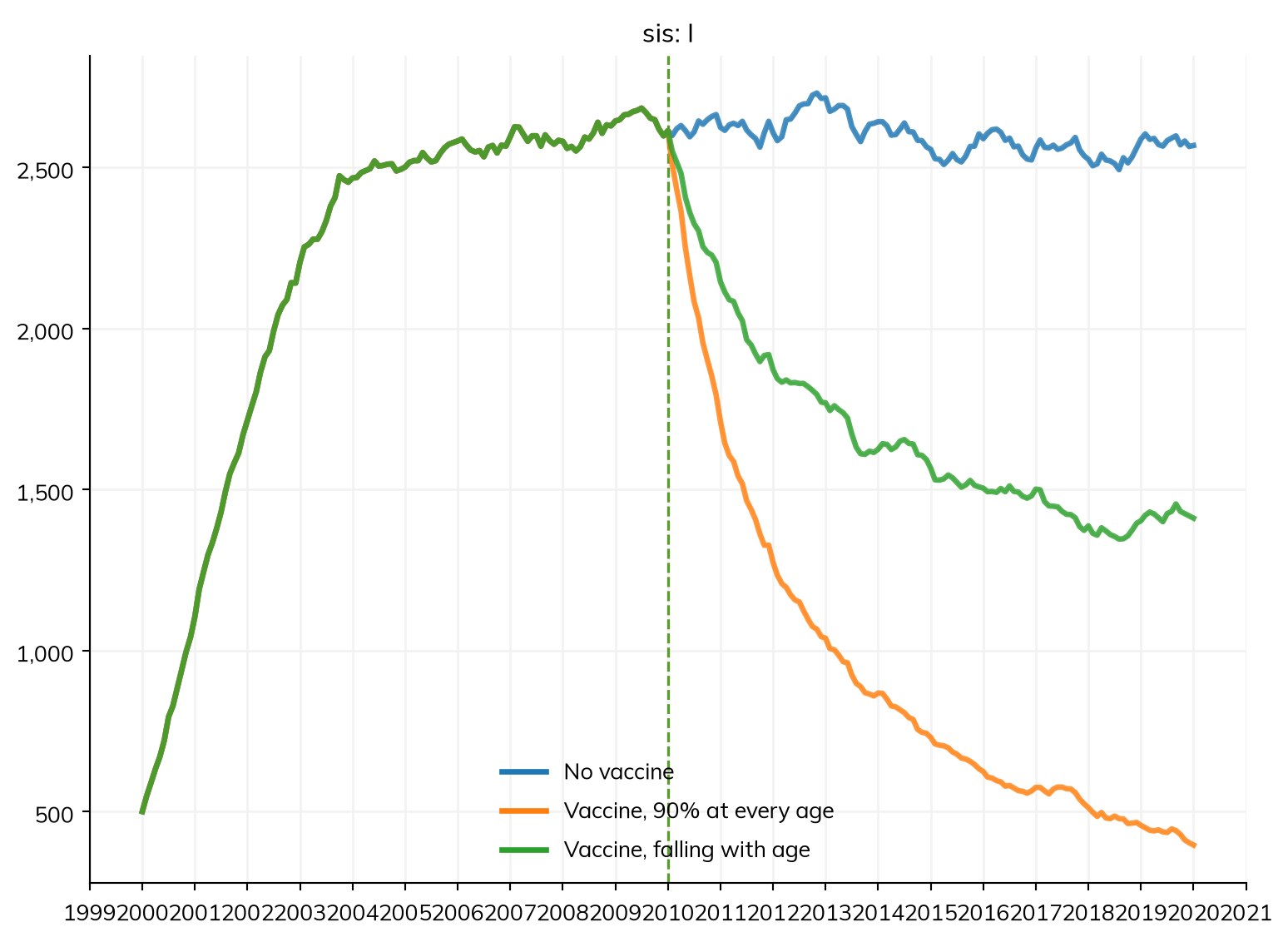
A product written as code runs as agents. This one changes susceptibility for good; a protection that should wane, or combine with other effects, is better given as efficacy= with waning=. administer() can also return outcomes, as a test does (dict(positive=uids)), which are then results and events of the delivery. An intervention whose logic is not a product at all is a subclass of ss.Intervention: see Interventions.
The API reference for this page: Products.
Further reading
- Covasim: Interventions: vaccines, testing, tracing, and treatment in an agent-based model of COVID-19
- epydemix: Vaccinations: vaccination in a compartmental model
- EpiModel: Vaccination: an all-or-nothing vaccine in a network model
Appendix: reference
Every product and its keywords
From each product’s documentation (the full text is in the API reference, Products):
import inspect, re
import pandas as pd

def keywords(cls):
    """ Each keyword in the Args of a class's docstring (and its bases'), with its meaning up to the first semicolon outside brackets """
    rows = {}
    for base in inspect.getmro(cls):
        if base in [ss.Module, ss.Product, ss.Intervention, ss.Connector]:
            break
        args = (inspect.getdoc(base) or '').partition('Args:\n')[2].split('\n\n')[0]
        for key, desc in re.findall(r'^    (\w+) \([^)]*\): (.*(?:\n {8,}.*)*)', args, flags=re.M):
            desc = ' '.join(desc.split())
            depth = 0
            for i, char in enumerate(desc):
                depth += (char in '([') - (char in ')]')
                if char == ';' and depth == 0:
                    desc = desc[:i]
                    break
            if key != 'kwargs':
                rows.setdefault(key, desc)
    return pd.DataFrame(rows.items(), columns=['Keyword', 'Meaning']).set_index('Keyword')

pd.set_option('display.max_colwidth', None)
pd.concat({f'ss.{product.__name__}': keywords(product) for product in [ss.Vaccine, ss.Diagnostic, ss.Treatment, ss.boxcar]})| Meaning | ||
|---|---|---|
| Keyword | ||
| ss.Vaccine | efficacy | protection against acquisition (required) |
| waning | how protection is lost, as above | |
| doses | for a vaccine given in doses, the relative efficacy after each (e.g. `[0.85, 1.0]`) | |
| leaky | if True (the default), everyone who receives it is partly protected (by `efficacy`) | |
| during | if given, it is held only while people are in these states (e.g. `during=sir.I`): they stop holding it when they leave them | |
| cost | the cost of each delivery | |
| name | the name | |
| label | the label, for plots and printing | |
| ss.Diagnostic | sensitivity | the probability that someone with the condition tests positive |
| specificity | the probability that someone without it tests negative | |
| outcomes | instead of sensitivity and specificity, the outcomes in order of severity, most severe first, each with its probability for people in each state (a dict by state, of any disease, as for `sensitivity`; a number is for those with what `detects=` says) | |
| result_delay | the time from the test to its result (agents only) | |
| detects | the condition the test detects (default: being in an infected state of the disease) | |
| cost | the cost of each delivery | |
| name | the name | |
| label | the label, for plots and printing | |
| ss.Treatment | cure | the probability that treatment cures (1 if neither `cure` nor `efficacy` is given) |
| efficacy | the effects while it is held, as for `ss.Vaccine` (e.g. `dict(transmission=0.96, mortality=0.9)`) | |
| moves | what it moves people along, instead of a cure by the disease's recovery: transitions of the disease (by name too), or a move written with the states (e.g. `I + CIN >> S`) | |
| waning | as for `ss.Vaccine`, for the effects while held | |
| during | as for `ss.Vaccine`: held (and its effects acting) only while people are in these states, e.g. `during=typhoid.acute` | |
| cost | the cost of each delivery | |
| name | the name | |
| doses | the relative efficacy after each dose | |
| label | the label, for plots and printing | |
| ss.boxcar | plateau | how long protection is full |
| decay | then, the e-folding time of its exponential decline (the mean time it lasts after the plateau) | |
| stages | the number of levels of the plateau in a compartmental run |
The outcomes of products and deliveries
Each of these is an event, which can trigger a delivery (when=), and a result of the delivery (the number on each step). Each also remembers, for each person, whether it happened (.ever), how often (.n_times), and how long ago (.since, agents only). An outcome of a product (test.positive) is for any delivery of it, and one of a delivery (screening.positive) for that delivery only.
| Event | Of | Who it is, on the step |
|---|---|---|
The delivery itself, e.g. when=vaccination |
Every delivery | The people it reached |
positive, negative |
A test (ss.Diagnostic) |
Those with each result (after the test’s result_delay=) |
Each name in outcomes=, e.g. screening.high |
A test with outcomes= |
Those with that result; positive is any but the last, and negative the last |
cured, failed, unneeded |
A treatment that cures or moves people (cure= or moves=) |
Those cured; infected and not cured; not infected (or in no source of the transitions it cures along) |
never_ran |
A delivery with queue= a duration |
Those still waiting when their time in the queue ran out |
held (a condition, not an event) |
A product, e.g. who=vaccine.held, or every product of a kind, ss.Vaccine.held |
Those who hold it now |
The transitions of a disease (measles.infection, or a branch, tr.to(state)) and the events of pregnancy (pregnancy.birth) are events in the same way; see Interventions.
What efficacy and waning can be
| Keyword | Form | Meaning | Solvers |
|---|---|---|---|
efficacy= |
A number | Protection against acquisition | All |
dict(acquisition=..., transmission=..., mortality=...) |
Protection against infection, infectiousness when infected, and death from the disease | All | |
A dict by transition, e.g. dict(progression=0.5) |
Scales the rate of that transition | All | |
A dict by disease, e.g. dict(hpv16=0.9975, hpv18=0.9975) |
Protection against each disease, with disease=[...] |
All | |
An ss.by() over the strains of a disease, one value per strain |
Protection against acquiring each strain | All | |
leaky=False |
A number | All or nothing: that fraction fully protected, the rest not at all | All |
doses= |
A list, e.g. [0.85, 1.0] |
The fraction of the full protection after each dose | All |
waning= |
A duration, e.g. ss.years(3) |
Protection lost after an exponentially distributed time with that mean | All |
ss.boxcar(plateau=..., decay=...) |
Full for plateau, then (with decay=) an exponential decline; stages= is the number of levels in a compartmental run |
Agents; approximated by compartments (the end of the plateau is spread out) | |
A function, fn(t) or fn(t, sim, uids) |
The fraction of protection left at a time t since delivery |
Agents | |
A dict by effect, e.g. dict(acquisition=ss.boxcar(plateau=ss.years(1)), transmission=None) |
Each effect its own waning | As its parts | |
during= |
A condition, e.g. sis.I |
Held only while people are in these states | All |
| A move instead of a product | A move between states as the event’s first argument, e.g. ss.Event(S >> V, ...) |
Protection as states of the disease, with any rates of their own | All |